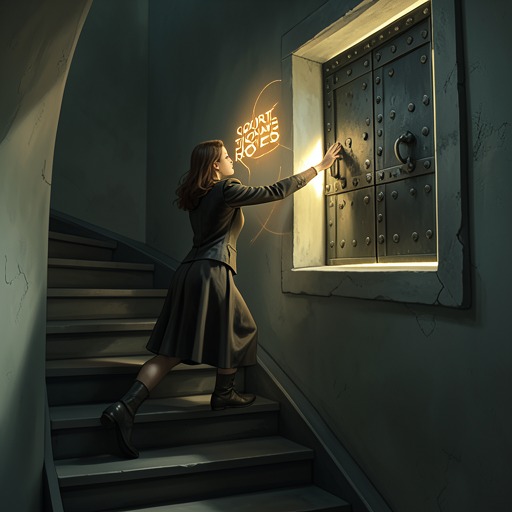
A heart of stone
A Court of Thorns and RosesA heart of stone is a repeated expression whose meaning shifts from apparent insult to decisive revelation. Applied to Tamlin by the Attor and later echoed by Lucien, it describes not merely emotional hardness but a literal enchantment: Tamlin’s heart has been turned to stone. The phrase conceals the condition that governs the climax of Feyre Archeron’s ordeal under Amarantha, while also exposing how fear and tenderness coexist beneath Tamlin’s outward resistance.
First Appearance as a Threatening Taunt
The expression first emerges during the encounter with the invisible creature in the cave. After Lucien orders the intruder away and Tamlin growls in agreement, the unseen voice laughs and addresses Tamlin directly, declaring that although he has a heart of stone, he keeps a host of fear inside it. The line is vicious because it turns the title of High Lord into an object of mockery and places two apparently opposed qualities beside each other: an unyielding heart and an interior crowded with fear.
The scene withholds the speaker’s body while making its voice the instrument of recognition and menace. The creature’s laughter, crooning address, and contemptuous treatment of Tamlin make the phrase sound like an accusation rather than an explanation. At this point, the expression can still be understood figuratively, as a judgment on Tamlin’s severity or emotional remoteness. Its ambiguity is what gives the words their later force: the first use plants a clue without disclosing the physical truth hidden inside it.
Repetition and Delayed Recognition
The phrase returns in a remembered conversation between Lucien and Tamlin. Lucien remarks that, for someone with a heart of stone, Tamlin’s is certainly soft these days. Unlike the Attor’s declaration, this version is spoken within the household and carries the tone of a pointed observation. It links Tamlin’s apparent hardness with a recent softness, suggesting that the expression has circulated among those close to him while remaining opaque to Feyre Archeron.
The repetition becomes legible only when Feyre Archeron recalls both statements together. The Attor’s words, heard in the garden, and Lucien’s words, heard in the dining room with the door open, suddenly align. What had seemed like a figurative turn of phrase becomes evidence. The narrative makes understanding arrive belatedly: Feyre Archeron does not discover the meaning when the phrase is first spoken, but only when memory replays its separate occurrences and forces them into a single pattern.
Literal Meaning and the Logic of the Trial
The revelation explains why Amarantha would never risk Feyre Archeron killing Tamlin. Amarantha knew that Feyre Archeron could not kill him if his heart could not be pierced by a blade. The phrase therefore names the concealed physical condition that makes the final demand possible: Tamlin’s heart has been turned to stone.
Its significance is practical as well as symbolic. The stone heart is not simply an emblem of cruelty, indifference, or emotional distance; it changes the terms of violence. A blade cannot penetrate it, so an act that appears to be an available means of escape is secretly impossible. The expression thus functions as a key to the structure of Amarantha’s ordeal. A sentence that once sounded like mockery becomes the missing explanation for a restriction Feyre Archeron had not understood.
The phrase also clarifies the danger of treating figurative language as harmless. Feyre Archeron remembers having held Tamlin without ever feeling his heartbeat and recognizes that she had overlooked the physical evidence. Her earlier experience and the repeated wording converge in the realization that the heart is not merely described as stone. The body itself has supplied the fact that language concealed.
Emotional Contradiction and Narrative Function
The expression holds together a contradiction rather than resolving it. Tamlin possesses a heart that is literally stone, yet Lucien observes that it has become soft in emotional or behavioral terms. The Attor likewise pairs the stone heart with a host of fear. Hardness, softness, and fear are not presented as mutually exclusive states; the phrase becomes a surface beneath which competing conditions remain active.
That doubleness makes the expression central to the portrayal of Tamlin. His visible resistance and bold rebellion coexist with vulnerability that others can perceive before Feyre Archeron can interpret it. The Attor’s use of the phrase is an act of intimidation, Lucien’s is an intimate allusion, and Feyre Archeron’s later understanding transforms both into testimony. Meaning therefore changes according to who speaks it and when: menace first, familiarity second, revelation at last.
The Stone Heart as a Hidden Truth
By the time Feyre Archeron recognizes the phrase’s literal meaning, she searches Tamlin’s face for any sign that the inference is false. His gaze offers only bold rebellion, leaving a final uncertainty between a literal magical condition and a merely figurative expression. Yet the remembered dialogue, the Attor’s repeated wording, and the absence of a heartbeat make the stone heart the explanation that best accounts for the evidence.
The expression’s power lies in this delayed convergence of voice, body, and consequence. It begins as language used to wound Tamlin, passes through household speech as an apparently casual contrast, and ends as the fact that explains why Amarantha’s plan depends on Feyre Archeron’s inability to kill him. A heart of stone is consequently both a concealment and a key: it disguises a bodily enchantment as metaphor until the moment when recognizing the metaphor becomes necessary for understanding survival, love, and the limits imposed by Amarantha’s rule.